Geo-Tech Industries
The TrenchGeo-Tech Industries is the corporation whose deep-sea infrastructure turns the Mariana Trench into both a scientific frontier and a field for commercial and geopolitical competition. It finances and operates the Benthos and its submersibles, supports a lucrative research partnership, and pursues alternative-energy technology. Across these projects, the company’s public purposes and private interests repeatedly overlap: the same systems that enable research also provide cover, leverage, and access to a hazardous environment whose risks fall heavily on crews and partners.
Corporate Reach and Deep-Sea Infrastructure
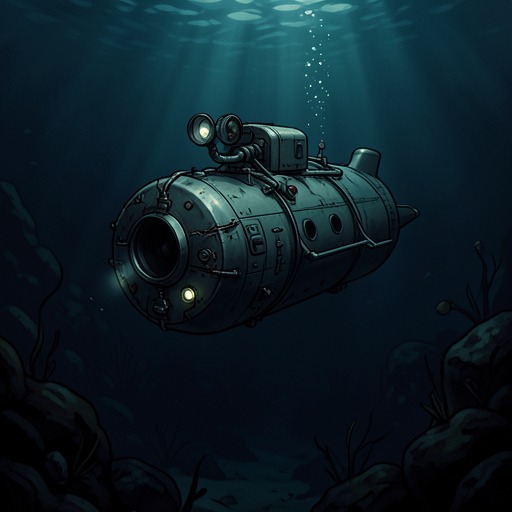
The Benthos embodies Geo-Tech Industries’ scale and ambition. It is described as a mobile deep-sea laboratory community and submarine docking station: a 46,000-square-foot titanium structure, suspended above the seafloor in neutral buoyancy on three large shock absorbers. Its size makes it a base for extended operations, but its dependence on coordinated submersible missions also means that a delay or navigational danger can place an entire team under pressure. During one deployment, team leader Ellis Richards complains that the Proteus has covered only six kilometers in three hours and stresses that the Prometheus and Epimetheus are expected to arrive topside early the following week. His impatience reflects the timetable imposed on the expedition; the pilot, Barry Leace, answers that keeping the crew alive matters more than risking them to protect a bonus or schedule.
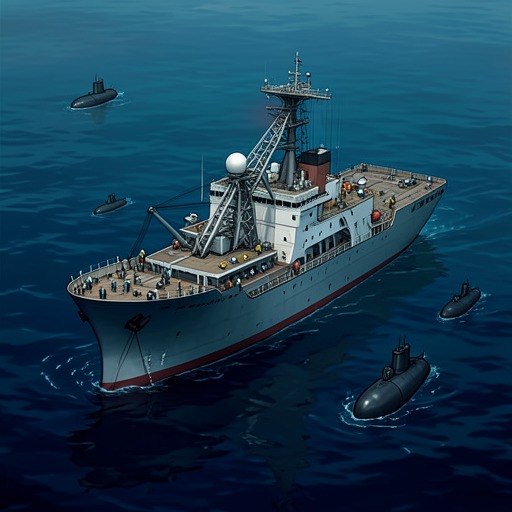
Geo-Tech’s surface operations are represented by the Goliath, an 813-foot decommissioned Kirov-class Soviet missile cruiser donated by the Russian government under a twenty-year contract to develop and supply alternative-energy resources. Its hybrid nuclear-and-steam power plant drives two sets of turbines and twin propellers, and the vessel can cruise at thirty-three knots. With its battle armor removed, it nevertheless retains the size and power needed to transport and deploy the Benthos. The arrangement links the company’s deep-sea research capacity to a far larger energy agreement: the Goliath is not merely transport, but a conspicuous piece of infrastructure through which Geo-Tech can support operations in the trench.
Research Partnerships and Disputed Accountability
Geo-Tech’s expansion is intertwined with the financial crisis of the Tanaka Oceanographic Institute. After a jury awarded damages exceeding expectations and the courts rejected appeals, the Institute was forced into bankruptcy. JAMSTEC then offered a lucrative contract to deploy a UNIS array along the Mariana Trench floor in response to increased seismic activity along the Philippine and Pacific tectonic plates. Because the return to the abyss posed dangers for Masao Tanaka, he sought Benedict Singer’s help. Singer, then building a fleet of deep-sea submersibles, formed a partnership with him; Tanaka surrendered controlling interest in the Institute so it could fulfill the contract and keep its attraction open.
The partnership’s legitimacy is later placed under strain by the Proteus disaster. Geo-Tech’s stated explanation is that a piloting error caused the submersible to implode. Richard Diefendorf doubts that account, describing the pilot as an experienced former Navy man whose caution made him suited to operating at depth, and suspects the company is concealing something. The available evidence presents this as a suspicion, not a proven account of the accident. Terry Tanaka-Taylor’s report to JAMSTEC, by contrast, formally attributes the loss of hull integrity to pilot error, possibly after the starboard bow plane struck a black smoker. It says that sonar records showed nothing unusual before the loss, that Geo-Tech had begun restitution to the surviving families of four victims, and that the Tanaka Institute sought permission to continue the UNIS deployment.
Terry later believes that the account was made possible by altered evidence. She accuses Benedict of changing sonar records so that she would submit a clean report, and says that people aboard both the Goliath and the Benthos knew creatures had attacked the Proteus. The contrast between the official report and her suspicion shows how technical records and institutional statements shape what can be recognized as an accident. Geo-Tech’s account supports continuing operations; the disputed interpretation raises the possibility that the cost of doing so has been obscured.
Commercial Aims and Hidden Energy Interests
Geo-Tech’s energy ambitions extend beyond its surface contract. An account of Benedict Singer’s dealings describes a secret meeting with Osama bin Laden, a financier of the National Islamic Front, at which Benedict demonstrated a prototype fuel that reportedly produced an exceptionally powerful fusion reaction. Bin Laden and his associates agreed to finance Geo-Tech’s work in exchange for partial control of the technology. With their financial and political backing, Benedict recruited specialists from Russia and the Middle East to help construct what might become the world’s first true tokamak fusion reactor. The Central Intelligence Agency regards the project as consequential because successful fusion could shift the balance of power for decades and place a major energy technology under the influence of Benedict’s backers.
The deeper source of the energy project is revealed through the manganese nodules Geo-Tech has collected. Benedict explains that the nodules contain a distinctive mixture of Helium-3 and deuterium compatible with a long-burning fusion reaction. He connects the material to an earlier expedition by Prestis and Shaffer aboard the Seacliff: their suction equipment collected nodules from a remote area of the Mariana Trench they called Devil’s Purgatory, and he suspects its vibrations attracted the Megalodon. The Navy confiscated the nodules after the attack, without recognizing their value; Benedict later obtained some and tested them in his laboratory. His account gives the company’s deep-sea presence a second, concealed purpose. The search for scientific knowledge and the search for a strategic fuel source occupy the same terrain, but serve different interests.
Terry identifies another concealed aim when Benedict tests her understanding of the operation. She concludes that Geo-Tech is using the UNIS deployment as cover to mine manganese nodules within the Mariana Trench, which falls under Exclusive Economic Zone laws. Benedict approves her deduction and asks why the company would undertake such an expensive effort merely to mine nodules. His response points beyond ordinary extraction toward the fuel’s value, while the arrangement itself exposes a conflict between a publicly presented scientific mission and commercial activity conducted under its protection.
Risk, Leverage, and Institutional Consequences
Geo-Tech’s operational decisions repeatedly distribute risk unevenly. Richards presses Leace to catch up with the Benthos and invokes the expected arrival of other submersibles; Leace insists that survival takes precedence over the schedule. Captain Hoppe later objects that the Prometheus is being sent too far ahead of the Benthos and challenges the effort to compress a six-month mission into sixty days. His objection makes the central tension explicit: the expedition’s timetable is an organizational choice, while the dangers of operating at depth are borne by its crew. The company’s ability to deploy advanced equipment does not make those dangers controllable.
The company also becomes a financial participant in a proposed effort to capture the Megalodon near Grays Harbor. The plan depends on drawing the animal into the bay and closing gill nets across the inlet, which is roughly three miles wide and only fifty to sixty feet deep in the relevant area. Westport Marina requires Geo-Tech to guarantee payment for damage to fishing vessels, as well as an additional ten thousand dollars for labor and expenses, before moving the vessels into position. The negotiation shows how the company’s resources can make a dangerous intervention possible, while also making the operation dependent on commercial assurances and local property at risk.
The later political revelations complicate the Institute’s financial collapse. Masao learns that the lucrative JAMSTEC contract was arranged to give Benedict a legitimate opportunity to access the Mariana Trench and asks whether the lawsuits and denied appeal were part of a plan to bankrupt his company. Dave Ross confirms that the UNIS project was selected as a suitable opportunity for access, but the exchange does not independently establish that Geo-Tech engineered the lawsuits or the court’s decision. It does, however, reveal that the appearance of a legitimate research mission served a strategic purpose beyond the research itself. The Benthos’s eventual structural failure, as pressure buckles its outer hull and level B implodes, brings the physical vulnerability of the enterprise into view: Geo-Tech can build a vast platform for reaching the abyss, but neither its scale nor its scientific and commercial designs can insulate those inside it from the conditions below.
Narrative Significance
Geo-Tech Industries links the novel’s corporate, scientific, and exploration plots. Its vessels make work in the Mariana Trench possible; its contracts connect private investment to government and research institutions; and its fusion ambitions turn seabed material into a potential source of global power. At the same time, the disputed Proteus report and the hidden mining operation expose the limits of institutional assurances. The company’s defining contradiction is not simply that it seeks profit alongside research, but that its pursuit of access and energy depends on presenting hazardous, contested operations as orderly and legitimate. The deep-sea machinery extends corporate reach, yet the crew’s exposure, the uncertain record of the disaster, and the eventual failure of the Benthos show how little control that reach guarantees.